€8.10
Regular price:
€9.00

White teas
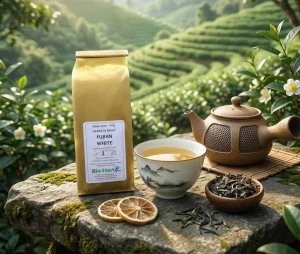
White teas are made from young leaf buds and the youngest leaves collected from the Camellia sinensis bush, most often in spring. They are dried immediately. Young buds and leaves are covered with white fuzz - hence the name of the tea.
The infusions obtained from them have a light, delicate colour. Subsequent infusions are milder. The leaves are brewed at a water temperature of about 75-85 degrees Celsius for 2-5 minutes and brewed 1-2 times (this is the case in Europe). Approx. 1g of leaves per 100ml of water is used here. In the Far East, white tea is first "waked up", i.e. it is poured with water very briefly and immediately poured out. Only then are the pre-soaked leaves treated with water at a temperature of about 80 degrees C for half a minute. He brews there 3-5 times and each time about ten seconds longer. But the doses of tea are much higher because they usually use 3-5g of leaves per 100ml of water.
White teas contain more biologically active substances than green ones, which is why they have a stronger anti-aging and anti-radical effect. We find alkaloids, amino acids, lipids, phenolic compounds (strong antioxidants) in them. Dried leaves also contain some vitamins C, A, E, K, and from the B group. We will find numerous minerals in them, such as potassium, calcium, magnesium, aluminum, manganese, iron, selenium, and fluorine. There is also theine (a form of caffeine), which accelerates heart rate, increases metabolic rate, improves concentration, reflexes, reduces drowsiness, improves mood.