€8.10
Regular price:
€9.00
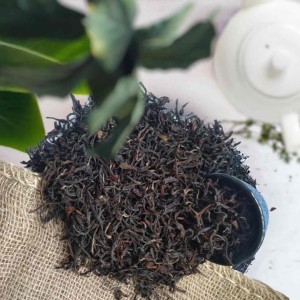
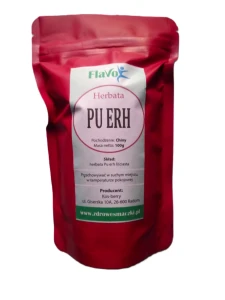
Red teas (Puerh) and Oolong (Wulong)
They are obtained by incomplete fermentation of green leaves, which in the case of red Pu erh tea (called dark in China) is interrupted when the ends of the leaves turn red-brown. Obtaining Pu erh teas consists in drying the leaves after harvesting, automatic oxidation and stopping it (at a temperature of up to 65 degrees C), shaping the leaves (flattening, rolling them into mechanical or manual balls), drying them again and either leaving them in this form for a certain period ( even years) to naturally mature as so-called shengi or "raw" pu erh, or they are subjected to a process of wo dui (like forced maturation) as a result of which the so-called shu pu erh. The water process (like oxidation-fermentation) consists in gathering the leaves into mounds and covering them for a certain period of time, which in conditions of humidity and elevated temperature leads to their faster "maturation" (ageing). The mounds can be processed even several times so that the leaves do not overheat. This maturation (ageing) process, which can take up to two months, involves fungi (including yeast) naturally present in and around the casing material.
Oolong (Wulong) teas are also called turquoise, blue, emerald and in China referred to as the Black Dragon. Immediately after harvesting and when the leaves are withered, they are subjected to the process of "infringement" (damage) in rolling machines (formerly manually in baskets). Oxidation then takes place simultaneously, which is stopped by heating. Then the leaves are shaped, dried again and left sealed for some time (ageing). You can also roast such leaves instead of keeping them.
Puerh and Oolong teas are oxidized in the range of 20-90%. They contain many biologically active compounds, such as secondary metabolites, i.e. alkaloids, polyphenols (e.g. flavonoids - including tannins), minerals such as calcium, magnesium, iron, selenium, vitamin E or group B.
The content of theine (a form of caffeine) combined with the presence of tannins helps to burn fats faster.
Puerh tea has a lot of oxalates, so don't overdo it, as it can interfere with kidney function.
These teas are brewed in water at a temperature of 80-90 degrees Celsius and can be brewed several times (good, old pu-erh even several times). The infusion has a calming and relaxing effect. Shorter brewing gives a stimulating, refreshing tea.